Dairy Queen Nutrition Menu
Welcome. This hub helps you use official nutrition facts and the online calculator to order with more confidence across the United States.
Here you’ll find more than calories. We explain macros, sugar, sodium, and serving sizes so you can compare treats and hot items. The goal is clear: choose lighter options, balance macronutrients, or simply know what you’re ordering before you get to the window.
The site pulls official info from the brand’s nutrition facts and allergy pages. Keep in mind values can vary by location because many outlets are franchised. Portioning and prep differences may change the numbers you see on PDFs or in the calculator.
We also cover allergens and cross-contact at ice cream shops, including gluten and nut warnings, in plain language. Menu tables in this article include live price fields where available so you can compare quickly while traveling.
Inside the Dairy Queen nutrition tools you’ll use in the United States
Start with the filter: a quick way to match treats to your daily calorie target. The site lets you set a calories cap, search specific items, toggle available vs. discontinued entries, and spot items marked “voted a healthy and tasty option.”
How to filter by calories and search items to match your goals
Use the calorie filter to shrink the list to what fits your plan. Then search by name to find cones, Blizzards®, or sandwiches. Open an item to compare versions—cone vs. dipped cone, or small vs. medium Blizzard®—and check serving sizes side by side.
Why published information and the nutrition calculator can differ by location
Published nutrition information gives a stable baseline. The calculator builds a current order. Store-to-store variation can occur in franchised restaurants. Different suppliers, portioning, or a busy shift can change sugar and fat totals.
Use the calculator for the freshest build. Cross-check the published information when you need a steady comparison.
| Tool | Last updated | What it filters | Quick tip |
|---|---|---|---|
| Menu filter tool | 10/14/2025 | ≤ calories, availability, healthy tag | Set calories first, then search items by name |
| Search bar | Real time | Item names, flavors, sizes | Compare small vs. medium in details |
| Nutrition calculator | Real time | Custom builds and add-ons | Use for current location builds; cross-check published info |
Dairy Queen Nutrition Menu: calories, macros, and what to look for before you order
Small changes in size can send calories soaring—here’s how to spot them. Scan an item for calories first. Then check total fat and saturated fat. Next look at sugar, then sodium. This order finds most surprises fast.
Serving size is the real “hidden ingredient.” A Small Vanilla Cone lists about 230 calories while a Large shows 480. A Small Dipped Cone is roughly 340 versus 710 for a Large. A Small OREO® Blizzard® can be 570 calories; a Large reaches about 1010.
“Creamy” items often mean higher saturated fat. Mix-ins, chocolate coatings, and syrups push sugar higher than the base soft serve. Ingredients and portioning can vary across franchised restaurants, so compare item vs. item and size vs. size rather than chasing perfection.
| Item | Small (cal) | Large (cal) |
|---|---|---|
| Vanilla Cone | 230 | 480 |
| Dipped Cone | 340 | 710 |
| OREO® Blizzard® | 570 | 1010 |
For quick comparisons, use the official guide or the online calculator linked at this brand page. It helps you match items to your daily calorie target before you order.
Frozen treats nutrition breakdown: soft serve, cones, sundaes, and Royal Treats®
Classic counter treats add big flavor with fairly simple math—know the base before the extras arrive. Below are quick numbers you can use when ordering.
Soft serve basics
Soft serve runs about 35 calories per fluid ounce. A 1/2 cup vanilla serving is roughly 140 calories. Chocolate hits about 150 calories for the same amount. Use those as your baseline before sauces or mix-ins.
Cones and dipped cones
Cones add carbs and modest calories: small 230, medium 330, large 480. Dipped cones jump due to the coating: small 340, medium 490, large 710. That coating brings more fat and sugar quickly.
Sundaes and toppings
Small strawberry sundaes sit near 240 calories; chocolate versions are about 280. Large strawberry is roughly 500, and large chocolate 580. Chocolate or fudge raises sugar and calories more than fruit sauces.
Royal Treats® and cakes
Specials are best for sharing or a treat-yourself moment. Examples: Banana Split 510 cal, Peanut Buster® Parfait 730, Triple Chocolate Utopia™ 770, Brownie Earthquake™ 740. One slice of an 8″ frozen cake is about 370 calories per 1/8 slice.
| Item | Small (cal) | Large (cal) |
|---|---|---|
| Vanilla Cone | 230 | 480 |
| Dipped Cone | 340 | 710 |
| Strawberry Sundae | 240 | 500 |
Quick decision guide: pick smaller sizes and lighter sauces to keep calories lower. Save parfaits and layered treats for special occasions.
Blizzard® Treat nutrition: what changes by size and mix-ins
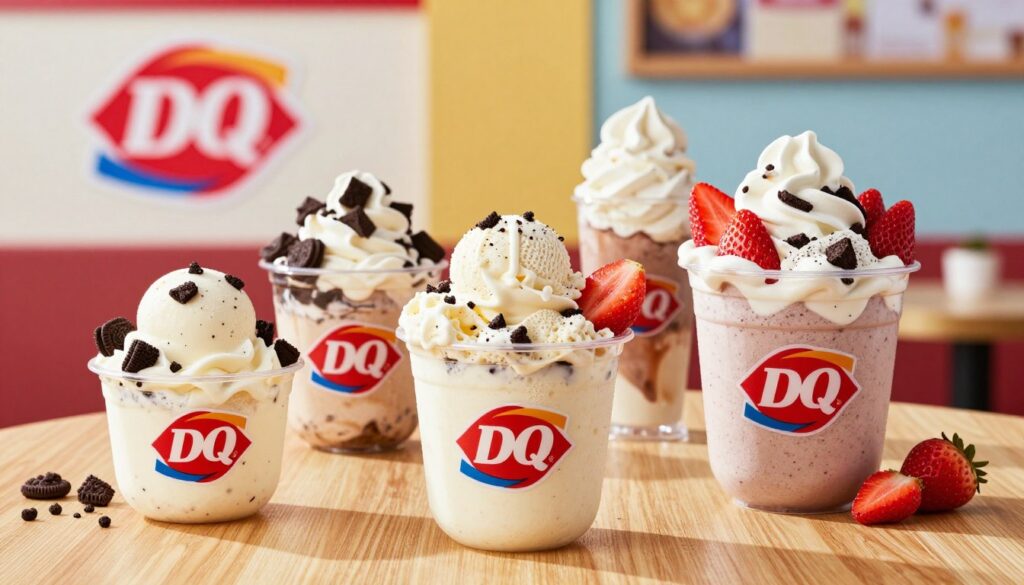
Choosing a Blizzard® starts with the flavor, then the size decides the calorie hit. Pick the mix-in you want. Next, match that flavor to the size you can live with.
Size comparison strategy: small vs. medium vs. large
Use size to control how many calories you take in. A small keeps the experience and trims big macro spikes. A medium can easily cross into meal territory.
| Flavor | Small (cal) | Medium (cal) | Large (cal) |
|---|---|---|---|
| OREO® Cookies | 570 | 700 | 1010 |
| Chocolate Chip Cookie Dough | 720 | 1030 | 1320 |
| Classic Chocolate | approx. 520 | approx. 640 | approx. 920 |
Popular flavors spotlight and mix-ins
Mix-ins like cookies, dough pieces, and sauces drive sugar and fat more than the soft serve base. OREO® and cookie dough-style Blizzards® are common go-to orders that are easy to underestimate.
Cross-contact note and a simple script
The same mixing machine blends every flavor. Assume possible cross-contact if you have allergies or strict limits.
- Ordering tip: ask for a smaller size to keep the same flavor but fewer calories and less sugar.
- Script to use: “Can you please run the machine cleaner and thoroughly wipe the blade before making this flavor?”
Novelties and packaged bars: lower-calorie options and sealed-wrapper guidance
Packaged treats are the tidy option: steady portions and labels you can read before you buy. They work well when you want clear nutrition facts and fewer unknowns at the counter.
Why sealed wrappers help if you’re gluten-sensitive
Look for items in clear, sealed plastic wrappers. These products—Dilly Bars, Buster Bar Treats, Fudge Bars, Vanilla Orange Bars, and Starkiss® Bars—are manufactured off-site without wheat, rye, oats, or barley in the recipe. That lowers store-level handling risk.
No sugar added picks and what “50 calories or less” implies
Smaller calorie counts often mean a smaller portion and less fat. Examples: DQ® Fudge Bar (No Sugar Added) 50 calories; Vanilla Orange Bar (No Sugar Added) 60 calories; Starkiss® 80 calories. Read the label to confirm.
| Item | Calories | Wrapper |
|---|---|---|
| Fudge Bar (No Sugar Added) | 50 | Sealed plastic |
| Vanilla Orange Bar | 60 | Sealed plastic |
| Starkiss® Bar | 80 | Sealed plastic |
Note: bars handed in paper bags are made on site and face cross-contact risk. Staff cannot guarantee any product is free from peanut or other nuts. Always check the label and ask staff to confirm the exact wrapped item you’re getting.
Food menu nutrition: burgers, chicken, baskets, fries, and salads
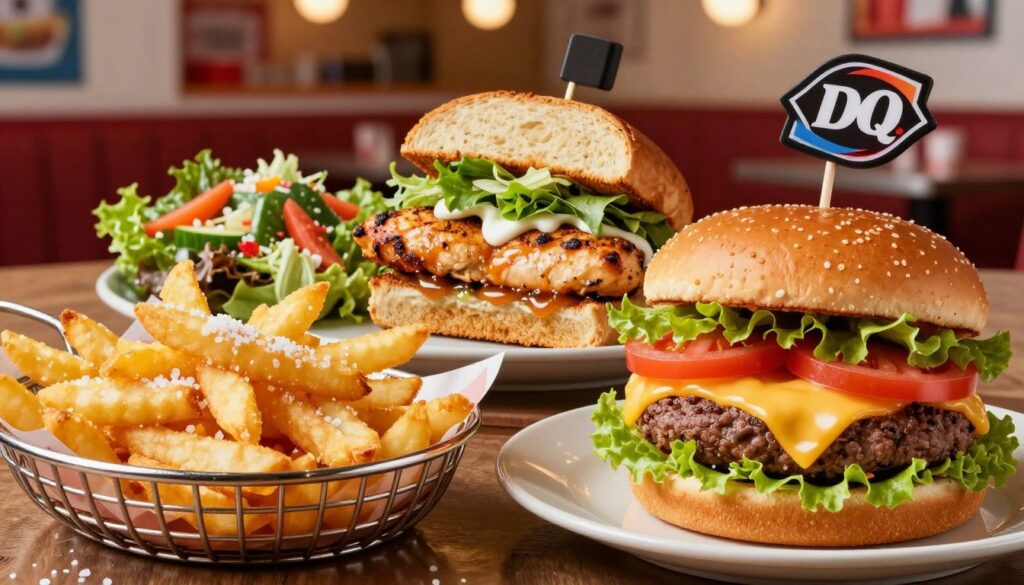
Treat the food lineup like a plate you build: pick a main, add a side, then decide on sauces or dressing. This helps you keep calories steady and enjoy what you want.
Burgers and doubles
A Homestyle® Hamburger is 290 calories and 630 mg sodium. A Cheeseburger adds cheese and rises to 340 calories and 850 mg sodium. Doubling patties jumps to 540 calories and 1130 mg sodium.
Chicken choices
Choose grilled to cut calories. The Grilled Chicken Sandwich is 340 calories. The Breaded Chicken Sandwich is 510 calories and more fat. The Chicken Strip Basket™ is a high-sodium choice at about 1000 calories and 2510 mg sodium.
Fries, onion rings, and sides
Small fries are around 300 calories, medium 380, and large 480. Onion rings sit near 470 calories. Fried items are prepared in a 100% vegetable oil blend.
Salads and dressings
Without dressing, a Grilled Chicken Salad is about 240 calories (950 mg sodium listed) and a Crispy Chicken Salad is 350 calories (620 mg sodium). Dressings swing totals fast. Fat free Italian adds about 25 calories. DQ® Ranch is 310 calories; Blue Cheese is 210. Fat Free Ranch is 60.
| Item | Calories | Sodium (mg) | Real-time price |
|---|---|---|---|
| Homestyle® Hamburger | 290 | 630 | $2.79 |
| Grilled Chicken Sandwich | 340 | 950 | $4.29 |
| Chicken Strip Basket™ | 1000 | 2510 | $6.99 |
| Small Fries | 300 | 300 | $1.99 |
Practical pairing: if you plan a Blizzard® later, pick a smaller side or a light dressing now. That keeps the meal balanced and still comforting at these restaurants.
Allergens, gluten sensitivity, and peanut considerations at Dairy Queen restaurants
If you or someone with you has allergies, treat both ingredients and handling as risk factors. Labels list ingredients, but busy counters and shared tools change the picture.
Where gluten cross-contact happens
Shared equipment is common. Fryers, cone dips, mixing blades, and utensils touch many items in quick succession.
That fast pace makes strict separation difficult. The brand’s guidance is clear: they cannot guarantee any item is free from gluten.
Gluten-sensitive ordering guidance
When cross-contact matters most, choose sealed, manufactured novelties. Packaged bars (Dilly Bars, Buster Bar Treats, Fudge Bars, Vanilla Orange Bars, Starkiss® Bars) arrive in plastic wrappers and have lower handling risk.
Avoid on-site paper-bag items and in-store cakes when you need strict gluten-safe handling.
Peanut and nut allergy warning
Even if a product lists no nuts, the company warns it cannot guarantee peanut-free or nut-free preparation. Assume cross-contact is possible unless the store can show otherwise.
Best practice at the counter
- Ask to speak with the manager before ordering.
- Request to see product labels for current ingredient information.
- If you need a Blizzard® flavor, ask staff to wipe and clean the mixing blade before making it.
| Risk point | Why it matters | Smart action |
|---|---|---|
| Shared fryers | Fried items can pick up gluten or nut residues | Choose packaged items or ask about fryer use |
| Mixing machine | One blade mixes all flavors; cross-contact is likely | Request a thorough clean or pick a sealed novelty |
| In-store handling | Utensils and cones touch many items quickly | Talk to manager and inspect labels before ordering |
Putting it all together for smarter Dairy Queen ordering today
Tie it all together with a few simple habits that make ordering easier.
Use this quick checklist: pick a treat category, pick a size, then scan calories, saturated fat, sugar, and sodium before you pay.
If you want a Blizzard® or a slice of cake, pair it with a lighter main or a small side. Split large treats with the family. Pick one big item and keep the rest simple.
Choose “small first” for cones and dipped cones. Coatings, mix-ins, and creamy sauces add butter, cream, and sugar fast.
Remember franchised restaurants vary. Some regions use different soft-serve mixes for cakes and other items. Use the online filter, compare sizes, and ask the manager when allergens or exact info matter most.